Measurement

The Digital Product Passport Needs More Than Data. It Needs Distribution.

The Digital Product Passport Needs More Than Data. It Needs Distribution.

The Digital Product Passport Needs More Than Data. It Needs Distribution.

How Woopz Can Turn Product Information Into a Living Digital Product Passport

How Woopz Can Turn Product Information Into a Living Digital Product Passport

Woopz logo for Digital Product Passports

The Digital Product Passport is moving from an industry concept to a practical business requirement.

Under the European Union’s Ecodesign for Sustainable Products Regulation, Digital Product Passports will become an important way to store and share information about products placed on the European market. The regulation entered into force in July 2024 and establishes a framework for introducing product specific requirements across a wide range of categories. (Environment)

For brands, manufacturers, retailers, service providers, and consumers, this represents a major change in how product information is created, accessed, and used.

A Digital Product Passport can contain information about materials, origin, production, environmental performance, care, repair, recycling, and other product characteristics. The exact requirements will depend on future product specific rules, but the overall direction is clear.

Products are becoming connected to structured digital identities.

The challenge is not only creating those identities.

The real challenge is making them useful and available wherever the product appears.

Why Digital Product Passports Matter Now

The European market is moving toward greater product transparency and stronger circular economy requirements.

The Digital Product Passport is intended to make relevant product information accessible throughout the value chain. This can support consumers, businesses, public authorities, repair services, recyclers, and other participants who need reliable information about a product. (Industri og Næringsliv)

For consumers, this can provide a clearer understanding of what a product contains, where it comes from, and how it should be cared for.

For retailers, it can offer access to verified information that can support product presentation, customer service, and responsible sales.

For repair and recycling services, it can provide information that helps determine how a product should be handled later in its life.

For authorities, it can support access to information related to compliance and market surveillance.

This makes the Digital Product Passport much more than a sustainability page.

It has the potential to become a common information layer around a product.

From Compliance Requirement to Business Infrastructure

Many businesses will initially approach the Digital Product Passport as a compliance task.

That is understandable.

New rules often create immediate questions about data collection, technical standards, responsibility, cost, and implementation.

But treating the Digital Product Passport only as a regulatory obligation risks missing the larger opportunity.

A well implemented passport can become part of the digital infrastructure that follows a product through its entire lifecycle.

The same product information can support compliance, ecommerce, retail, customer service, authentication, repair, resale, and recycling.

Instead of creating separate information systems for each purpose, businesses can work toward one structured source of product information that can be distributed across many channels.

This is where the Digital Product Passport can move from being a cost to becoming an asset.

The Data Challenge

Most companies already have large amounts of product data.

The problem is that the information is often spread across several systems.

Material information may exist in one database.

Supplier data may be stored in documents or spreadsheets.

Product identifiers may sit inside an enterprise resource planning system.

Images and descriptions may be managed in a product information system.

Care instructions may exist in a separate file.

Sustainability data may be collected through manual processes or external platforms.

Creating a Digital Product Passport requires these different sources to work together.

The data must be collected, structured, connected to the correct product, and made available in a consistent format.

It must also be possible to update the information when the underlying product data changes.

This is not simply a design project.

It is a data infrastructure challenge.

The Distribution Challenge

Even when the data is available, another question remains.

How will people access it?

A Digital Product Passport has limited value when it can only be opened from one website or through one type of code.

Products move through many environments.

They appear in physical stores, online shops, marketplaces, warehouses, showrooms, repair centres, resale platforms, and recycling facilities.

Consumers may discover a product before purchasing it, while standing inside a store, after receiving an order, or several years later when the product needs repair or disposal.

Each situation requires a different access point.

A passport must therefore be designed for distribution, not only storage.

One Product Passport Across Every Channel

The Woopz platform is being explored as a distribution layer for Digital Product Passports.

The principle is simple.

Product data is brought together, structured into a digital passport, and made available through the channels where people already interact with the product.

The passport should not force every user into the same journey.

Instead, Woopz can make the same product information accessible through several interfaces and identifiers.

This creates a more practical model for brands, retailers, consumers, and service providers.

Access Through QR Codes

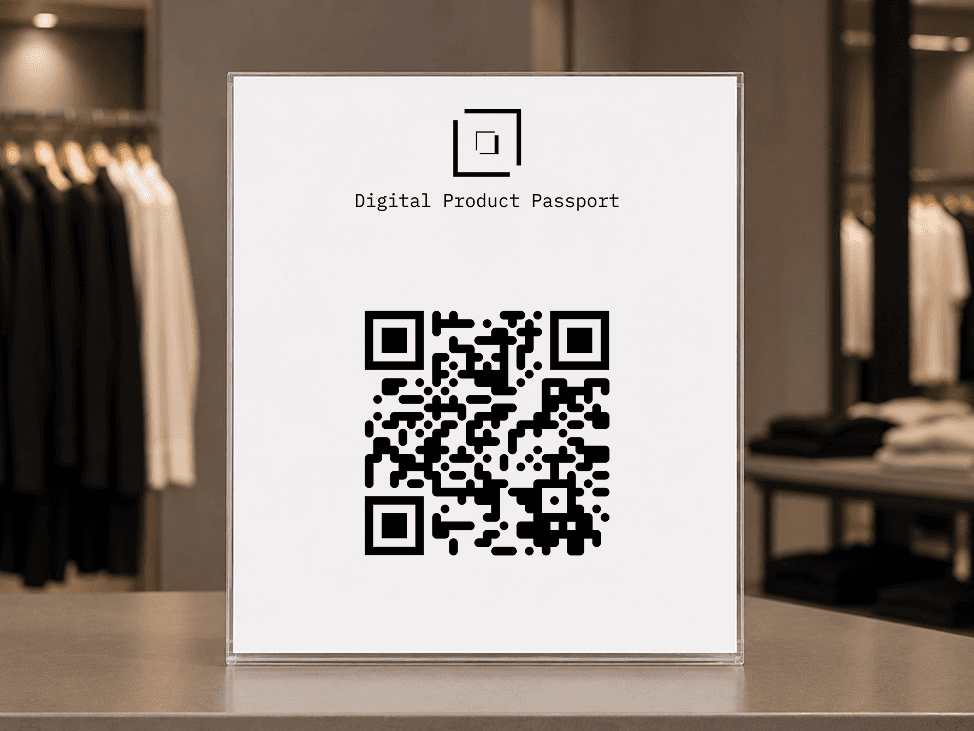
A QR code can connect a physical product directly to its Digital Product Passport.

The code can be placed on a product label, packaging, receipt, display, or in store material.

A customer can scan the code with a mobile device and open the relevant product information without downloading a dedicated application.

This creates a simple connection between the physical and digital product.

The current Woopz proof of concept demonstrates how a QR code on a garment label or inside a retail environment can lead directly to the product passport.

QR codes are especially useful because they are familiar, accessible, and easy to introduce into existing customer journeys.

Access Through Existing Barcodes

Products already carry identifiers.

Rather than depending entirely on new labels or new coding systems, Woopz is also researching how existing product identifiers can be used to resolve the correct Digital Product Passport.

This includes the ability to locate a passport through a product barcode.

The customer, retailer, or service provider can scan the identifier that is already connected to the product and access the relevant information.

This can reduce friction during implementation because businesses may be able to build on identification systems that are already present in their operations.

The Woopz proof of concept includes both QR code and barcode based access, showing how different physical identifiers can direct users toward the same underlying passport.

Access Through Product Search

A physical code will not always be available.

A customer may be researching a product online.

A retailer may need to locate information from a desktop computer.

A repair service may only have a product name, model, colour, article number, or stock keeping unit.

For these situations, product search becomes important.

The Woopz platform is testing a searchable interface where users can find a product and access its passport through available product information.

This allows the Digital Product Passport to remain accessible even when the user cannot scan the physical product.

Search also gives businesses a practical internal tool for customer service, operations, and product research.

Access Inside Ecommerce

Product information should be available before the purchase, not only after it.

Woopz is therefore researching how Digital Product Passport information can be embedded directly into ecommerce product pages.

Through a widget, relevant passport information can appear alongside the product description, price, images, size selection, and purchasing controls.

The customer does not need to leave the retailer’s website or navigate to a separate sustainability portal.

The information becomes part of the normal shopping experience.

The current proof of concept includes a widget designed for integration into ecommerce environments. It demonstrates how Digital Product Passport information can be presented directly on a product page.

This has the potential to make transparency visible at the point where purchasing decisions are made.

Access Through Retail Platforms

Retailers need accurate product information across several touchpoints.

The passport can potentially be integrated into store systems, product catalogues, clienteling tools, assisted sales interfaces, and other retail applications.

A store employee could access product information while helping a customer.

A retailer could present passport information on a digital display.

A customer could open the passport through a product page, receipt, QR code, or store application.

The important point is that the passport does not belong to one isolated interface.

It can become part of the wider retail journey.

Access Through APIs

Large businesses rarely operate through a single platform.

They use multiple ecommerce systems, retail systems, data platforms, mobile applications, logistics tools, and partner solutions.

An application programming interface allows Digital Product Passport data to move between these systems.

Instead of manually recreating the passport for each channel, businesses can retrieve structured information from the Woopz platform and use it inside their own services.

The Woopz proof of concept includes an API based approach that can provide structured access to product passport records and product identifiers.

This is important for scalability.

The goal is not to control every interface where the passport appears.

The goal is to make reliable product information available to the systems that need it.

A Distribution Layer for the Product Lifecycle

The Digital Product Passport may be introduced through regulation, but its relevance extends far beyond the moment of compliance.

Before a purchase, it can support product discovery and transparency.

At the point of sale, it can help customers and retail employees access reliable information.

After the purchase, it can provide care instructions and product details.

During repair, it can support access to material and construction information.

During resale, it can help communicate product characteristics and history.

At the end of the product’s life, it can provide information that supports sorting, recycling, and responsible handling.

A strong Digital Product Passport platform should therefore support the full product lifecycle.

It should make information accessible at the right moment, through the right channel, for the right audience.

Reducing Complexity for Brands

The introduction of Digital Product Passports could create significant complexity for brands.

Without a shared distribution layer, a company may need to create separate solutions for product labels, retail stores, ecommerce sites, marketplaces, internal systems, service partners, and public authorities.

Each solution creates additional development, maintenance, and integration work.

Woopz is researching a more centralised approach.

The company provides product information through its existing data sources.

Woopz connects to those sources, structures the relevant information, creates the passport, and distributes it through the required channels.

This does not remove the need for accurate source data.

It does, however, reduce the need to build an entirely separate distribution process for every touchpoint.

Keeping Product Information Consistent

When product information is copied manually between systems, inconsistencies appear quickly.

One ecommerce site may display updated information while another shows an older version.

A QR code may lead to one dataset while an internal system uses another.

A retailer may receive a product file that no longer reflects the latest source information.

A central platform can help reduce this problem.

The product passport is connected to structured data and distributed from a common source.

When information is updated, the connected access points can retrieve the latest available version.

This creates a stronger foundation for consistency across markets, retailers, platforms, and physical products.

Designing for Different Audiences

Not every user needs to see the same information.

A consumer may need care instructions, materials, origin information, and repair guidance.

A retailer may need commercial product data and verified sustainability information.

A repair provider may need technical details.

A recycler may need material composition and handling information.

An authority may need access to compliance related documentation.

The Digital Product Passport must therefore support different information needs without creating several disconnected passports for the same product.

Woopz is researching how the platform can structure and distribute relevant product information according to the context in which it is accessed.

The passport remains connected to the same product, while the presentation can be adapted to the user and channel.

The Passport Must Be Easy to Use

Technical compliance is not enough.

A passport may contain all the required information and still fail in practice when customers cannot find it, understand it, or use it.

The user experience matters.

The information must load quickly.

It must work on mobile devices.

The structure must be understandable.

The path from the product to the passport must be clear.

The most relevant information must be easy to locate.

This is one reason the Woopz research focuses heavily on several methods of access.

Users should be able to reach product information through the channel that feels natural in the moment.

Researching the Model Through a Proof of Concept

The Woopz Digital Product Passport platform is currently in a proof of concept and research phase.

The purpose of this phase is to test how product data can be collected, structured, displayed, searched, and distributed across different environments.

The current proof of concept explores access through QR codes, barcodes, product search, ecommerce widgets, and APIs. It also demonstrates a possible flow where existing business systems provide the source data and Woopz creates and distributes the resulting passports.

This is important because Digital Product Passports are still developing as a regulatory, technical, and commercial field.

Standards, product specific requirements, and implementation practices will continue to evolve.

Researching the model now gives Woopz and participating businesses an opportunity to understand the practical challenges before large scale implementation becomes necessary.

Positive Results So Far

The early results from the proof of concept have been promising.

The research indicates that a single product passport can be made accessible through several different channels without creating a separate underlying record for every use case.

It also shows that product information can be connected to common identifiers and presented through customer facing and system facing interfaces.

The proof of concept is not a final compliance solution.

It is a working foundation for further research, testing, integration, and validation.

The next stages will require continued work around data quality, technical standards, security, permissions, interoperability, user experience, and future regulatory requirements.

The progress so far suggests that the distribution problem can be solved in a practical and scalable way.

More Than a QR Code

The Digital Product Passport is often represented as a QR code.

But the QR code is only one entrance.

The real passport is the data, the systems behind it, and the infrastructure that makes the information available.

A successful implementation must work across physical products, websites, retail platforms, internal tools, applications, and partner systems.

It must support scanning, searching, embedding, and system integration.

It must work before, during, and after the sale.

That is the opportunity Woopz is researching.

Not simply creating another page of product information.

Creating the distribution layer that allows a Digital Product Passport to follow the product wherever it goes.

Building the Product Information Infrastructure of Tomorrow

Digital Product Passports are likely to change how businesses manage and communicate product information.

The companies that begin preparing early will be better positioned to understand their data, identify gaps, test integrations, and build useful customer experiences.

Woopz is approaching the Digital Product Passport as both a compliance challenge and a distribution opportunity.

One structured product identity.

Several access methods.

Every relevant sales and service channel.

The Digital Product Passport is not only about proving what a product is.

It is about making that information available wherever it creates value.